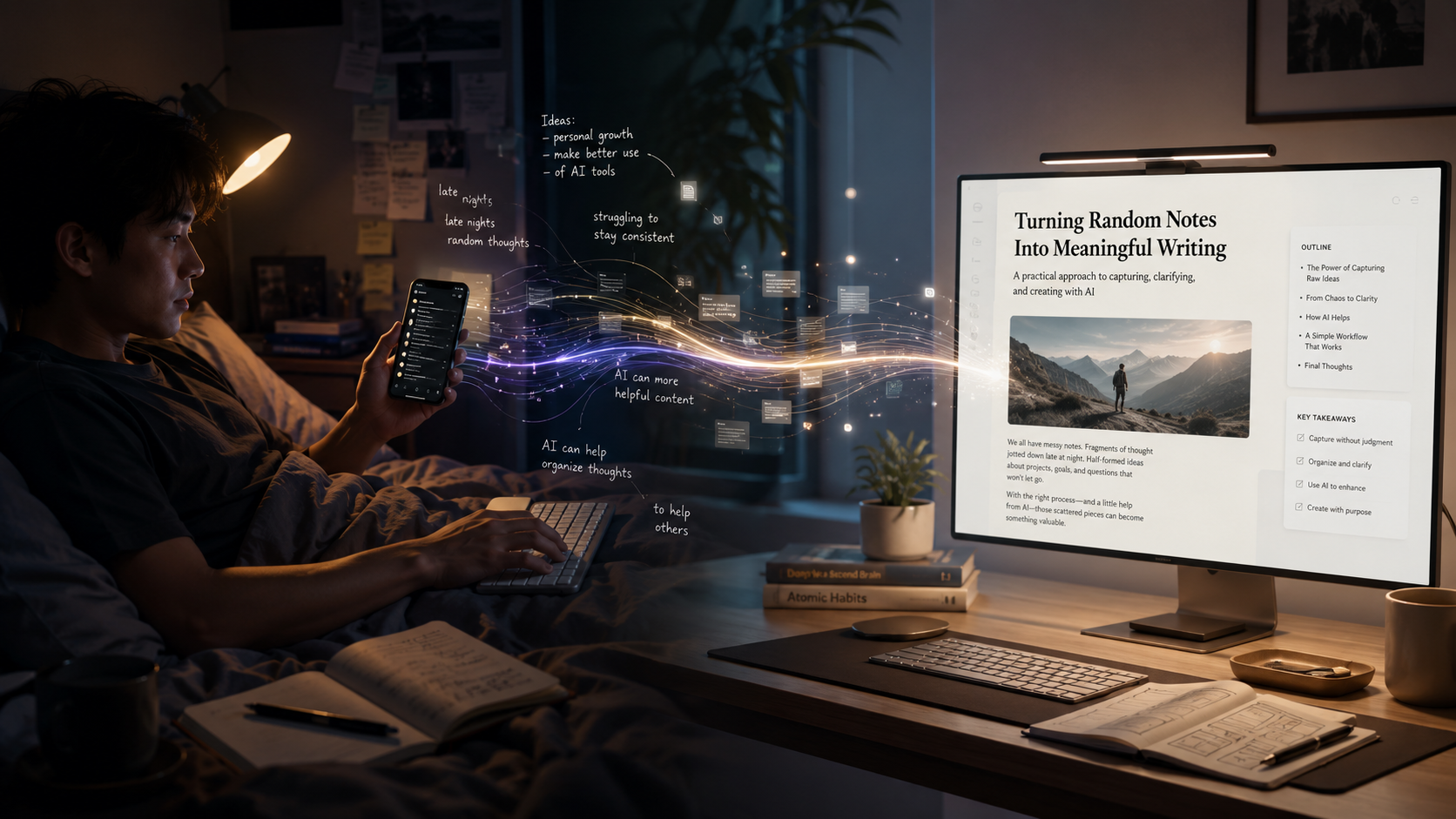
I have a lot of notes on my phone.
Small thoughts. Broken paragraphs. Strange sentences. Ideas that felt important for five minutes, and then disappeared into digital clutter.
Today I found one of those notes.
I don’t want to lose it. But I also don’t want to keep it as dead weight.
So the question is simple:
What can be done with a random note?
The Original Note
This is the note exactly as it was:
Your pain makes you who you are, especially in the beginning of your life. Slowly you notice that you are different than the rest of the kids around you. If you’re lucky, then you learn to be better at something. And that’s the confidence that can help you get by. You cling to it for support. It gives you courage, helps you persevere.
Get rid of stuff temporarily. Use this storage at your dacha.
Writing gives me joy. It gave Bukowski joy too. Although I’m sure there were many joyless nights and booze. There was always booze. I’m not much of a drinker.
That’s it.
Three different thoughts sitting together in one note.
Pain. Minimalism. Writing. Bukowski. Dacha storage. Booze.
A strange combination.
But maybe that is exactly why I like it.
A Cleaner Version
Here is the same note, cleaned up a little:
Pain shapes you, especially early in life. Slowly, you begin to notice that you are different from the kids around you. If you are lucky, you become good at something. That small skill gives you confidence. You cling to it. It helps you survive. It gives you courage. It teaches you to keep going.
Maybe minimalism doesn’t have to be dramatic. Maybe I don’t need to throw everything away immediately. I can move some things to the dacha. I can create space temporarily and see how it feels.
Writing gives me joy. It gave Bukowski joy too, although I’m sure there were many joyless nights. And booze. There was always booze. I’m not much of a drinker, so maybe writing has to be enough.
Now it has more shape.
It still sounds like me, but it breathes better.
What Is This Note Really About?
At first, the note looks random.
But maybe it is not random at all.
It is about survival.
First, you survive through pain. You feel different. You feel alone. Then you find something you can do. Maybe you become good at English. Or chess. Or writing. Or teaching. And suddenly you have something to hold on to.
Then you survive through space. You remove things. You try to breathe. You don’t want to be surrounded by old notebooks, old objects, old versions of yourself. You don’t want to destroy your past, but you don’t want to drown in it either.
Then you survive through writing.
You write because it gives you joy. Not pure joy. Not Instagram joy. Not fake joy. But real joy. The quiet kind. The kind that comes from making one sentence a little clearer than it was before.
The Image
If this note became an image, I imagine something simple.
A small wooden desk near a window.
A notebook open on the table.
A few old things packed into a box.
Outside the window, maybe a dacha, trees, silence.
No dramatic symbolism. No fire. No angel. No motivational quote.
Just a quiet place where a person is trying to create space.
Space in the room.
Space in the head.
Space in life.
How This Could Become an English Lesson
This note could also become a small English lesson.
Not a big lesson. Not grammar torture.
Just a short text with a few honest questions.
For example:
- Do you think pain can make a person stronger?
- What helped you feel confident when you were younger?
- Is it easy for you to throw things away?
- Do you prefer to keep memories or remove clutter?
- What gives you quiet joy?
- Do you have something in your life that helps you keep going?
That is enough.
A short text. A simple image. A few questions.
And suddenly a random note becomes a conversation.
What AI Did Here
AI did not invent the note.
The note was already there.
AI only helped me look at it from the outside.
It helped me clean it up, organize it, and see the connection between things that looked disconnected.
This is what I like about AI.
It does not have to replace your thinking.
It can help you notice your thinking.
It can take a messy note from your phone and ask:
“What is hiding here?”
Sometimes the answer is nothing.
Sometimes the answer is a blog post.
Sometimes the answer is a lesson.
Sometimes the answer is just a reminder that your old thoughts are not useless.
They are raw material.
Final Thought
Maybe I don’t need to keep every note.
But before I delete one, I want to ask:
Can this become something?
A paragraph?
A lesson?
A question?
An image?
A small piece of my website?
If the answer is yes, I keep it.
If the answer is no, I let it go.
That is the new rule.
Not everything must be saved.
But everything deserves one honest look.